
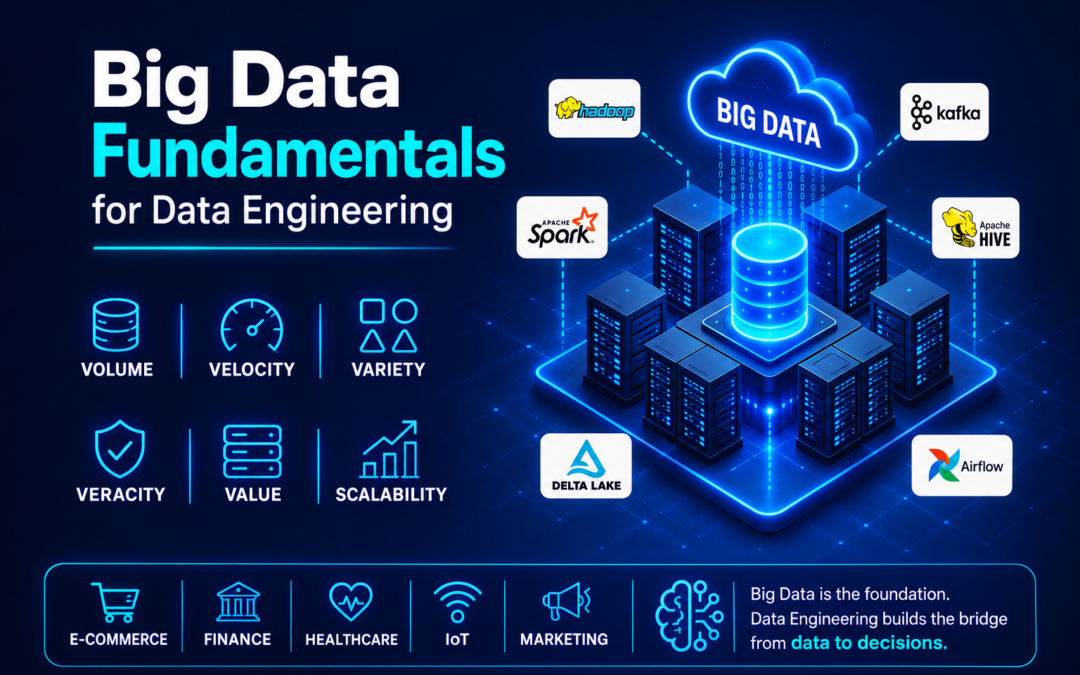
Big Data is no longer a buzzword—it’s the foundation of modern data engineering. As organizations generate unprecedented volumes of data from applications, sensors, logs, social platforms, and IoT devices, the ability to reliably collect, store, process, and serve that data becomes a core engineering discipline. This post covers the essential concepts every data engineer should understand.
What Is Big Data?
Big Data refers to datasets that are too large, fast, or complex for traditional relational databases and single-machine processing to handle effectively. The classic definition centers on the 3 Vs (later expanded):
- Volume — Scale measured in terabytes, petabytes, or beyond.
- Velocity — Speed of data generation and the need for near-real-time processing.
- Variety — Structured, semi-structured, and unstructured data (tables, JSON, logs, images, video, text).
- Veracity — Trustworthiness and quality of the data.
- Value — The business insight that can be extracted.
For data engineers, the practical challenge is building systems that can ingest, store, transform, and deliver this data reliably at scale.
Why Data Engineering Matters in the Big Data Era
Data scientists and analysts need clean, timely, trustworthy data. Data engineers build the pipelines, infrastructure, and platforms that make that possible. Core responsibilities include:
- Designing scalable ingestion systems
- Building reliable ETL/ELT pipelines
- Managing data lakes, warehouses, and lakehouses
- Ensuring data quality, lineage, and governance
- Optimizing for cost, performance, and reliability
- Without solid data engineering, even the best machine learning models or analytics dashboards fail.
Core Architectural Patterns
1. Batch vs. Stream Processing
Batch: Process large volumes of data at scheduled intervals (hourly, daily). Classic example: nightly ETL jobs.
Stream: Process data continuously as it arrives (event-by-event or micro-batches). Essential for real-time dashboards, fraud detection, and alerting.
Modern systems often combine both (Lambda or Kappa architectures).
2. Data Lakes, Warehouses, and Lakehouses
Data Lake: Stores raw data in its native format (usually object storage like S3, ADLS, or GCS). Highly flexible but can become a “data swamp” without governance.
Data Warehouse: Structured, curated, optimized for analytics (Snowflake, BigQuery, Redshift).
Lakehouse: Combines the flexibility of lakes with the reliability and performance of warehouses (Delta Lake, Apache Iceberg, Apache Hudi on top of object storage).
3. Distributed Systems Fundamentals
Big Data systems are almost always distributed. Key concepts data engineers must understand:
- Horizontal scaling — Adding more machines rather than bigger ones.
- Partitioning / Sharding — Splitting data across nodes.
- Replication — Keeping copies for fault tolerance.
- Consistency models — CAP theorem trade-offs (Consistency, Availability, Partition tolerance).
- Fault tolerance — Handling node failures gracefully (common in Hadoop, Spark, Kafka).
Foundational Technologies:
| Layer | Common Technologies | Purpose |
| Storage | HDFS, S3, ADLS, GCS, MinIO | Durable, scalable storage |
| Batch Processing | Apache Spark, Hadoop MapReduce, Presto/Trino | Large-scale transformations |
| Stream Processing | Apache Kafka, Apache Flink, Spark Streaming, Pulsar | Real-time ingestion & processing |
| Orchestration | Apache Airflow, Dagster, Prefect, Luigi | Pipeline scheduling & dependency management |
| Table Formats | Delta Lake, Iceberg, Hudi | ACID transactions on data lakes |
| Query Engines | Spark SQL, Presto, Trino, Athena | Interactive analytics |
Understanding when to use each tool—and how they fit together—is more important than mastering every one.
The Data Pipeline Lifecycle
A typical Big Data pipeline follows these stages:
- Ingestion — Collect data from sources (databases, APIs, message queues, files, change data capture).
- Storage — Land raw data in a data lake or staging area.
- Processing / Transformation — Clean, enrich, aggregate, and model the data (Spark jobs, dbt, Flink).
- Serving — Make data available via warehouses, feature stores, APIs, or search indexes.
- Monitoring & Observability — Track data quality, pipeline health, latency, and cost.
Modern best practices emphasize idempotency, schema evolution, data contracts, and observability (metrics, logs, lineage).
Key Challenges Data Engineers Face
- Schema drift and evolving data formats
- Late-arriving data and out-of-order events
- Data quality at scale
- Cost control (especially with cloud object storage and compute)
- Security and governance (access control, encryption, compliance)
- Debugging distributed systems
Addressing these requires both solid engineering practices and domain knowledge of the business data.
Getting Started: Practical Learning Path
- Learn the fundamentals of distributed systems and the CAP theorem.
- Master one batch framework (Apache Spark is the industry standard).
- Learn a streaming platform (Kafka is the most common entry point).
- Practice building end-to-end pipelines with orchestration tools.
- Understand modern table formats (Iceberg or Delta Lake).
- Study cloud data platforms (AWS, GCP, or Azure data services).
Hands-on projects beat theory. Build a pipeline that ingests public data, processes it with Spark, stores results in a lakehouse format, and serves it for analysis.
Conclusion
Big Data fundamentals are not about memorizing every tool—they are about understanding the principles of volume, velocity, variety, reliability, and scalability. Data engineers who internalize these concepts can design systems that remain robust as data grows by orders of magnitude.
The field continues to evolve (from pure Hadoop ecosystems toward cloud-native lakehouses and real-time platforms), but the core challenges remain the same: move data reliably, transform it correctly, and make it useful at scale.Master the fundamentals, stay curious about new patterns, and focus on building systems that deliver trustworthy data. That is the essence of modern data engineering.